Free US shipping on orders over $144.98 to the lower 48 states*. (Alaska & Hawaii - Call us to order.)

Proper Attic Ventilation

Our solar-powered attic ventilation fans are fans that work alongside a home’s passive venting system to boost its effectiveness in keeping attics cool and dry. Why is that important? Passive venting is the industry-wide standard for proper attic ventilation. Shingle manufacturers’ warranties and building codes require homes to be properly ventilated.

Attic ventilation is perhaps the most misunderstood area of roofing, and if neglected, leads to some very hideous and dangerous consequences. Ventilation is not an option; it is a necessity especially with today’s air-tight homes.

What's the Big Deal about Venting?

The reasons and the theory behind roof ventilation depends on the climate, but no matter where you live, proper roof ventilation should never be viewed as an option. Unfortunately, most homes in the United States do not have adequate ventilation, if they have any at all. And this lack of ventilation leads to many costly and avoidable repairs as well as wasted energy and potential health issues.

Hot Climates

In hot climates, ventilation is needed to remove the sun-heated attic air in order to lighten the burden of the home's cooling system which will save money.

Sunset over a desert in full bloom.

Cold Climates

In cold climates, ventilation is needed to avoid ice dams by maintaining a cold roof temperature. It is also needed to remove moisture that comes in from your living space below.

Aerial view of snow laden forest video.
Illustration that shows how air enters through the house's eaves and exits through the ridge vent. It shows that on a 90 degree sunny day, the roof deck can reach 170 degrees while the attic space can reach 140-150 degrees.

Ventilation Illustration

This illustration shows what happens to a home on a typical 90°F sunny day. The roof deck's temperature will reach 170°F and the attic will heat up to 140-150°F. Yes, you basically have an oven sitting on top of your living space.

These temperatures not only affect your home's ability to keep your living space cool, but they also negatively affect the longevity of your roof. The hot climate heat combined with an improperly ventilated attic will actually bake roof shingles and age them prematurely.

Colorful hot air ballon flying in a slightly cloudy blue sky.

Hot Air Rises

A home’s passive ventilation system is designed around the simple fact that hot air rises. That is why passive vents are installed as high on a roof as possible. Ridge venting makes the most sense as it lets air escape at the highest point on your roof.

Reasons Homes Need Proper Ventilation

  • Three pizzas baking inside a wood-fired oven with flames.

    An Attic is Like an Oven

    On a nice, sunny 90°F day, your roof deck is 170°F and your attic heats to 140-150°F. That's an oven on top of your living space.

  • Attic with wooden beams and insulation, showing signs of mold and mildew due to inadequate ventilation leading to condensation building up under the roof deck.

    Enemies of a Healthy Attic

    Heat and moisture are the biggest culprits to an unhealthy attic. Heat leads to roof deterioration and higher cooling costs. Moisture leads to mold, mildew, wood rot and deterioration of insulation r-value.

  • Two-story house with a blue exterior and white trim on a clear day.

    Modern Air Tight Homes

    All of a home’s heat, moisture and condensation that used to escape through walls and windows are now building up under the roof!

  • Wooden framing of an attic under construction with insulation.

    Most Neglected Room

    The attic is one of the most neglected spaces in a home. It’s dark, difficult to access and can easily be ignored as it is out-of-sight. It is time you stop neglecting this part of your home. Attics play a vital part in the health of your home.

  • Exterior of a house with beige siding and three rectangular soffit vents.

    Cool Air In, Hot Air Out

    That is the entire key to proper attic ventilation. The goal is to maintain uniform air movement across the entire length of attic from eave to ridge. Make sure your insulation is NOT blocking your soffit vents inside your attic!

More Information about Proper Ventilation

Benefits of a Properly Vented Roof

Balance is Key

A good roof design will include a balanced passive attic ventilation system. What that means is for every inch of air exhausted at the ridge, there needs to be a balanced amount of air coming in through the eave’s intake vents. You should never install only exhaust or only intake vents on your home. They must be balanced in order to effectively achieve air movement.

As the NRCA (National Roofing Contractors Association) states, it is not possible to vent more warn, moist air out of an attic than the amount of new air allowed into the attic such as with soffit or eave vents.

"In unbalanced attic ventilation situations where the NFVA at or near the top of the space being vented greatly exceeds that of the soffit or eave vents (such as is permitted in IBC 2012), it is possible for a slight negative pressure to be created in the attic space. This has the potential to allow conditioned air from the occupied areas below the attic to be drawn into the attic. Unsealed openings in the ceiling plain, such as ceiling recessed light fixtures, exhaust fan openings and plumbing vent stacks, are common areas of conditioned air loss into attics." (http://docserver.nrca.net/technical/9983.pdf)

Bottom line: That all adds up to higher energy costs as your conditioned air from inside your home gets sucked up into your attic. You don't want that so aim to have a balanced ventilation system in your home.

Uniform Air Movement is Crucial

Having a balanced passive attic ventilation system also means that there is uniform eave-to-ridge air movement across the ENTIRE length of the attic.

Air movement is crucial to maintaining a healthy attic. Proper passive ventilation allows the attic to breathe and has the following benefits:

  • Expels heat.
  • Expels moisture.
  • Reduces cooling costs. 
  • Reduces wood rot.
  • Increases roof life expectancy.
  • Reduces risk of mold and mildew growth. 
  • Keeps insulation fresh. 
  • Reduces attic air temp difference from outside air.
  • Reduces heating costs.
  • Stops heat transfer into living space.
  • Healthier attic makes for a healthier home.
  • Improves interior air quality.
  • Works all year around.

Benefits of Adding Solar-Powered Vents by Solar Blaster

Boost Your Passive Ventilation Using the Sun

Once a balanced passive vent system is achieved, boosting the effectiveness of that venting system is the advantage that Solar Blaster brings to the table. Multiple solar-powered attic fans that fit right inside the passive vents roofing professionals are installing on their homeowner’s roofs allow these vents to remove hot and moist air faster and even on non-windy days. We love the irony that we are utilizing the source of the heat problem, the sun, to also be the solution for removing the hot, moist air in attics. With multiple smaller solar-powered vents, you now have these benefits:

  • Expels heat faster.
  • Expels moisture faster.
  • Reduces cooling costs more.
  • Reduces wood rot more effectively.
  • Increases roof life expectancy longer.
  • Reduces risk of mold and mildew growth more effectively.
  • Keeps insulation fresh more effectively.
  • Reduces attic air temp difference from outside air faster.
  • Reduces heating costs more effectively.
    Stops heat transfer into living space more effectively.

Additional Benefits of Solar Blaster's Vents

  • Easy to install.
  • Less expensive than larger solar-powered fans. Bigger is NOT better (more to come).
  • Uses the source of heat to be the solution at no additional cost.
  • Multiple fans don't leave hot spots.
  • Does not require thermostat control.
  • Works even on non-windy days.
  • Installs from the roof top.
  • Works even on slightly cloudy days as they only need enough light to power at least one fan.
  • Activates passive vents to make them more efficient. 
  • Multiple fans promote uniform air movement across the entire attic.

What about Wind Turbine Vents?

Wind turbine vents require wind to operate so on still, hot and humid days, they do not operate. In addition, to be effective, you would need to place those ugly whirly bird vents across your entire roof line.

Do you really want multiple of these less-than-appealing vents up on your roof that only operate in certain weather conditions? Wind turbine ventilation is not your best choice for venting your home.

As we've said already, the sun is the source of the problem (not the wind), so allowing the sun to also be the solution is ideal. So regardless if the wind is blowing, when the sun is out, your vents are supercharged to exhaust that hot air. It's the best solution around.

Why Multiple, Smaller Solar Fans are the Key

Multiple, smaller solar fans that also act as passive vents are a much better and effective system. Your home's passive vents should be spaced evenly across the entire attic length and by adding a SolarBlaster vent solution to each vent, your vents will be much more effective in exhausting your attic air.

Also smaller solar fans require less power to start operating so our fans will work even on slightly cloudy days. They also don't require an on/off switch or thermostat to control them.

Remember, you want your passive vents to be working all the time day and night. With SolarBlaster's products, you can now activate your passive vents so the sun can start removing its own hot air during the day!

Science Backed

BIGGER is NOT Better

Comparison graphic of high volume powered attic vent air flow vs multiple low volume powered attic vent air flow.

Multiple Smaller Solar Vents Promote Better Uniform Air Movement

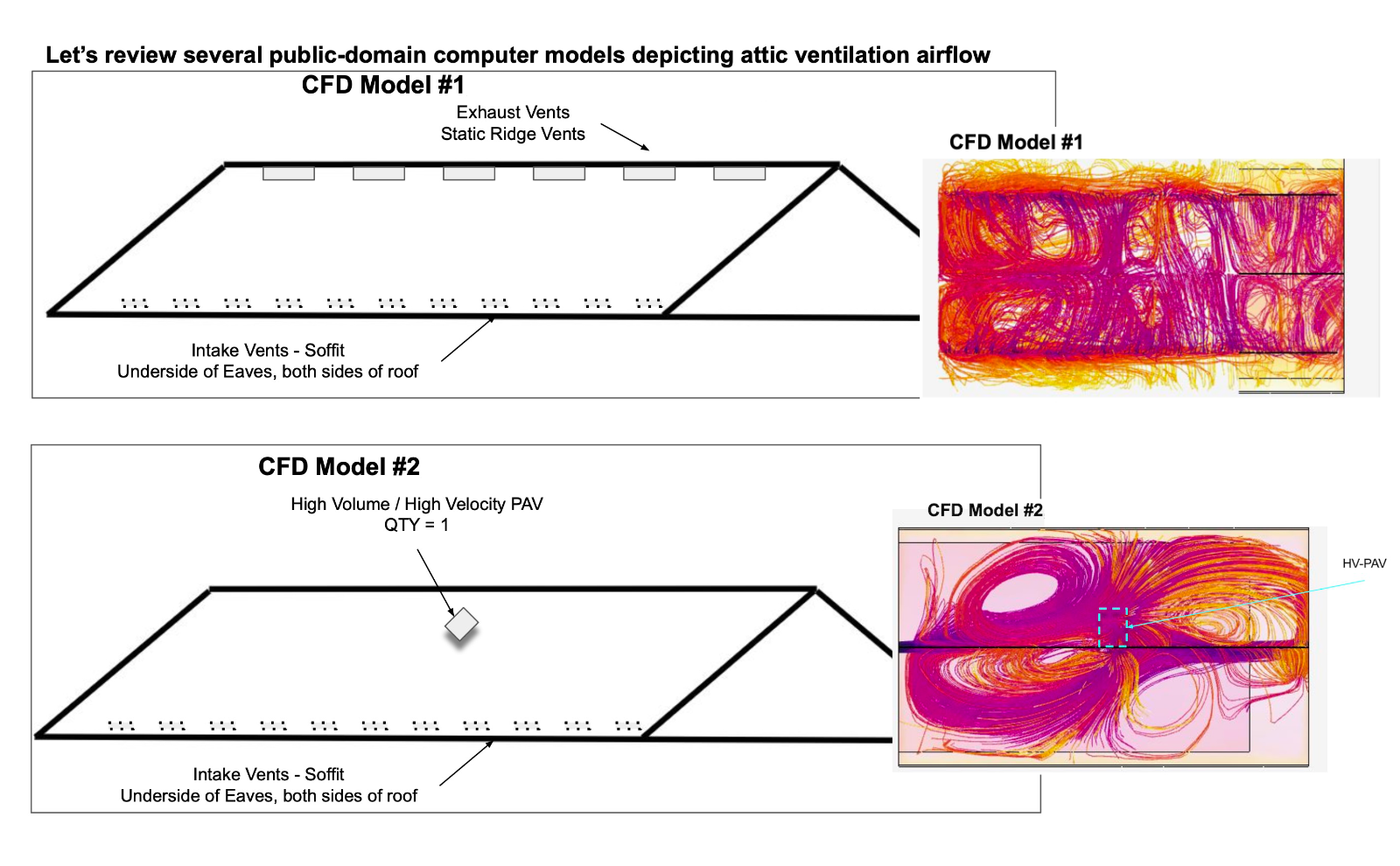
These CFD (Computational Fluid Dynamic) computer models illustrate why one large solar-powered vent fan is less effective in achieving uniform air movement than multiple smaller solar-powered vent fans spread across the entire attic's length.

CFD models of attic ventilation airflow with diagrams and color-coded airflow heat maps.

The above image compares the air flow between vents spread across the entire ridge vs one HV-PAV (high-velocity powered attic vent) fan being used in an attic This computer simulation is comparing the airflow of two attics:

Model #1 has uniform venting spread across the entire ridge length.

Model #2 has one large, high-velocity powered attic vent (HV-PAV) installed in the middle of the attic as high as it can go.

Both attics have soffit/eave vents all along both sides of the attic.

Take note that Model #1's thermal imaging is showing much more uniform air movement across the entire attic and roof space.

Notice on Model #2 that the airflow in through the intake soffit/eave vents is greatest in the region down-roof from the HV-PAV exhaust vent on both sides of the roof. It is only drawing in cool air from the middle sets of soffit/eave vents. This represents the path of least resistance for airflow when a high-volume/high-velocity powered vent is used. Notice the areas with lower/minimal airflow through the soffit/eave vents -- those are perfect locations for hot pockets (which will degrade the integrity of your shingled roof) and moisture accumulation (which can lead to mold growth and a decrease of the r-value of your insulation). Most often near corners and the edges of the roof -- regions often known for ice dams in the winter and moisture build-up in the summer.

Low-Volume Powered Attic Vents (LV-PAV) spread even across one's ridge and throughout the attic is the KEY to uniform air movement depicted in Model #1's thermal image.

Solar Blaster's entire product line was designed using these scientifically-proven principles and it is also why building codes across the US emphasis the need for adequate ventilation spread across the entire attic (both intake and exhaust vents).

Don't fall prey to Bigger is Better when it comes to ventilation. Lower CFM fans, like the ones Solar Blaster offers, spread across the entire ridge of your attic, helps establish more natural attic ventilation airflow patterns more quickly and effectively than static/passive exhaust vents as well as High-volume-PAVs.

Interviews

Watch as Dan Rheaume, creator of the Solar Blaster product lines, is interviewed by Dmitry from Roofing Insights.

Two men sitting in chairs in a studio setting with microphones and a fireplace.
Two men in a workshop setting with tools and equipment on the wall.